Well of Fortune & Secret of the Spores (New World)
Feature Breakdown: Well of Fortune
The Well of Fortune capitalized on New World: Aeternum’s revamped Cutlass Keys zone.
Cutlass Keys shipped with a specific idea behind it: create a PvP zone for players to freely jump into whenever they were in the mood for some greater risk/reward gameplay. This came with some interesting design questions, and the team strived to answer all of them in player-friendly ways.
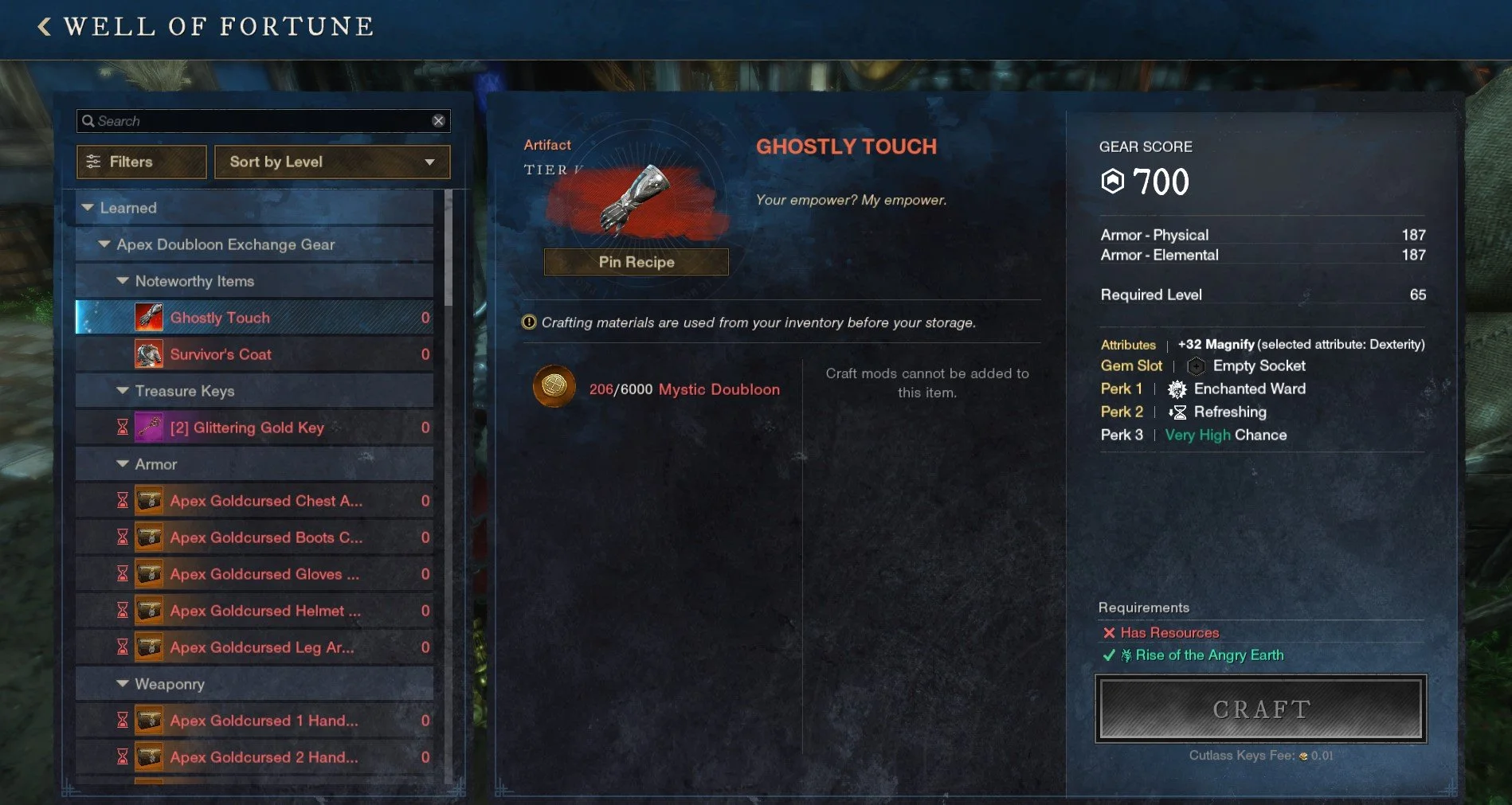
One design that I advocated for in particular is the streamlining of potential loot drops in the PvP zone down to a single currency: Doubloons. Inventory stress is fairly common in looter-type games like New World. In the much more dangerous Free-For-All PvP zone, where death meant losing hard-earned loot, an overencumbered player would become frustrated with the “normal” process of inspecting and dismantling gear, while under duress to keep a watchful eye for other players.
This design had the knock-on effect of quickly answering the question “how do we handle players losing infinite combinations of gear on a case-by-case basis?” In short, we wouldn’t need to. If no gear drops, then players can’t lose it, and the tech concerns become that much simpler.
As the design was built, I was the lead on the Doubloon Economy and rewards layer of the zone. My initial designs had the top-end items being very expensive to give players a long chase to build out their full gearset of max-level items. The Amazon team was concerned that players might turn to social exploitation (e.g. bringing in allies to deliberately feed doubloons to a single player) to gain more doubloons out of the PvP zone, which would contrast the only other content that offered max-level gear on a weekly lockout. A compromise was eventually reached: max-level items would be gated by a weekly component, and the prices would be brought down to facilitate players who didn’t have much time to endlessly grind, but who also didn’t have 9 other friends to do max-level PvE content.
The story beats on this feature were more “written in the margins” than many of the other systems I had developed up to this point. The basic premise of “there’s cursed gold out here, get rid of it in this here Well” was kind of the long and short of the feature’s narrative impact. Broadly speaking, players had quite a bit of visual storytelling with the general construction of the Well, the “Goldcursed” pirates in the PvP zone, and the piles and piles of gold in some of the deeper sections of the zone. I helped develop narrative hooks for later use, such as the description of the “Goldcursed Key” that was written to imply an unseen benefactor that the player could meet at a later time, but fundamentally, most things were merely hooks that narrative designers could latch onto as they desired.
Overall, I feel that the design was a success. We diligently tuned the inputs and outputs of the economy to give players enough in that if they wanted to endlessly grind, we had a few good sinks, and there were enough restrictions on the more volatile rewards that we didn’t risk the broader trading economy of the rest of the game.
Community-sourced Feature Breakdown: https://www.youtube.com/watch?v=9XnyNld_Am0
Feature Breakdown: Secret of the Spores
As part of the Rise of the Angry Earth expansion, Lost Boys Interactive was tasked with revamping the old “First Light” zone into the new “Elysian Wilds” zone. As we built the zone revamp pitch, I noticed that we didn’t have a crafting feature that would bring an equivalence from the previous expansion (Brimstone Sands), so I took it upon myself to build one, resulting in Secret of the Spores. The initiative was met with praise from the Amazon team, as they had already been hoping to make the end-game zones feel a little more distinct through different investment and gameplay features.

After many brainstorming and iteration sessions, we settled on the final product: players would be gifted a reusable “bottle” that they would be able to fill with “juice” crafted from spore plants spread across the zone. The resulting potion, when consumed, would give the player either offensive or defensive buffs to make both combat and the loot/crafting experience more rewarding while they explored the revamped area.
I was responsible for all non-art aspects of the feature. I created the plant that would be placed in the world by the level design team (and gave feedback as needed for adjustments), I developed the buff/perk system and its technical functions, and I developed the gathering and loot economies for all the new materials and added rewards.
The last bit of design work was overseeing the functionality of the intro quest, as well as the narrative justification for the spores in the first place. This required working closely with the quest and narrative design teams, while also explaining the technical design of the spore pods and their arrangement in the zone.
This feature started as somewhat ambitious, but if it had one flaw, it was that it attempted to please a few too many interested parties. It had to connect to all the open world features in the zone, hence the intricate ingredient requirements. It had to make the higher tradeskill ceilings “worth it” for the price, so the initial design had the crafting skill requirements be astronomical (this was thankfully tuned down). It had to match zone progression, so there were several types of collectible spores and a matching number of “tiers” to upgrade the bottle and its juice. The initial design incorporated some risk: the plants that players would harvest their “spores” from was originally the source of a dangerous but not lethal debuff, a system that was received well by community pre-testers. This was removed in favor of a “positives only” experience at the request of leadership, with no time to iterate on the potion buffs and potentially tune them down to compensate.
Overall, I am still proud of the feature, especially its economy. The “defense” potion granted much more resource per harvest event, meaning that the crafters in the audience had room to sell “juice” to others, and the “offense” potion had its own unique loot pool for dedicated players to chase useful gear.
Community-sourced Feature Breakdown: https://www.youtube.com/watch?v=0TpSTmmuFb4
