Challenges (Tony Hawk’s Pro Skater 1+2)
This feature for the remaster of the first two Tony Hawk games was conceived by the team as something that would help build a bridge between the early games’ simplistic approaches to long-term player investment (i.e.: just play the whole game over again on a different character) and the new audiences that we wanted to attract to the game who might have been more used to progressions found in Fortnite and other live service games.
As the feature owner, I was tasked with designing and building the challenge system tool and its associated menu, with the direct support of the lead engineer and the UI art team. It began with paper designs and pitching concepts (like the player profile and tracker widgets present on the main menu) before turning to some proofs of concept to fill out the roster. Many of the early challenges were synonymous with progressions that would fit with the profile’s stat tracker: high scores for each map, each skater, and all-time, largest combo for each map, each skater, and all-time, and trick counts (flips, grabs, and grinds).
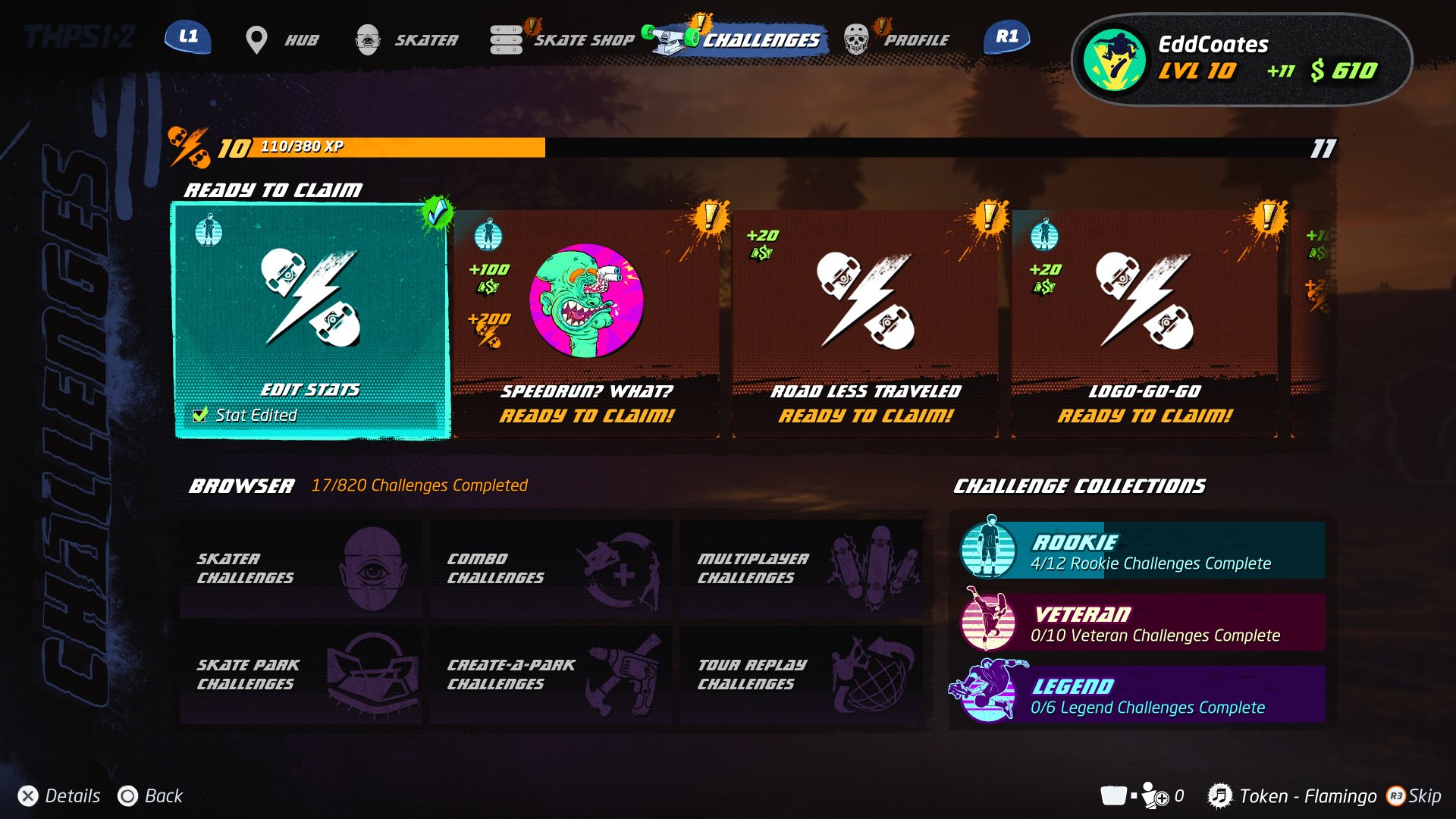
I built the feature through an iteration feedback loop. I would develop an idea, implement and test its technical feasibility, then share it with the systems team or more broadly for feedback, then make adjustments and take in additional ideas for further iteration. The tool eventually became so modular that it was used in several other areas of the game: shop unlocks based on player level progression, achievements, and even most of the secret content was routed through the challenge system.
A noteworthy aspect of the iteration process is the development of the menu’s overall flow. The individual “tiles” of the menu had to be interactable for tracking, rewards claim, and gaining further details. The button assignments and logic for that system went through several iterations based on a balance of the needs for feature utility, the broader UX flows of the game, and what would “feel good” for players. Tracking existed so that players could self direct. “Rewards claim” existed because it “felt good” when a player was able to claim their rewards in rapid succession at one location. All of these aspects had to be balanced in a way that felt intuitive to players.
The construction of both the system and its menu taught me so much about code etiquette, technical communications, and Unreal Engine’s Blueprints scripting interface, as well as UX design principles of which I was in entirely new territory at the time.
Community-sourced Feature Breakdown: https://www.youtube.com/watch?v=2aN3vh6XO84
