Sleeper Nodes (Destiny 2: Warmind)
Destiny 2: Warmind was the first game industry product I ever worked on. It and the other Destiny releases I helped develop taught me an incredible amount about game design and understanding the technical aspects of game development.
Sleeper Nodes was built from a specific desire of our Principle Designer for Warmind: The destination should have a large number of hidden caches that players have to complete puzzles to access. The direct inspiration was The Legend of Zelda: Breath of the Wild’s “Korok Seeds” feature, where players would find simple gameplay components and configure them to solve the puzzle and earn a Seed. This concept went through several iterations, in part because I started off with something exceptionally complex that was not well supported by the game’s UI system.
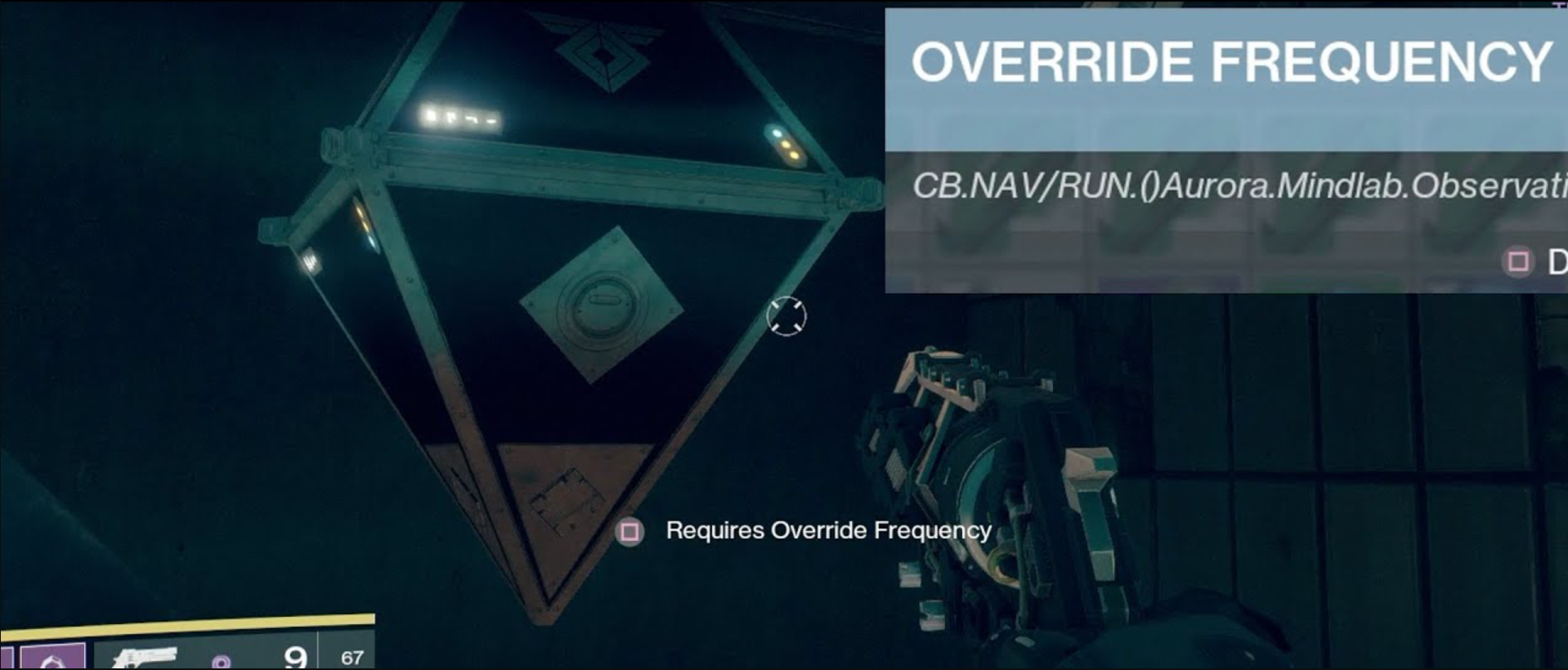
The system that shipped took more inspiration from my time playing the larger game. Part of the as-yet-unreleased Destiny 2 base game involved a mission that was intended to foreshadow the Warmind DLC, and the diamond-shaped game objects (pictured to the right) present in that mission inspired me to build a more freeform and less encounter-driven experience.
In Warmind, players could build “keys” out of components collected from world activities, the key would be randomly generated but tied to a specific Node given via 3 words of increasing location specificity, and players would receive pieces of loot as a reward.
Once the basic gameplay loop was constructed, I iterated on (among other things) the process for acquiring key components and the overall behavior of the Nodes. Key components came from activities, because having them come from kills felt too random and the items themselves tended to be unmanageable if they didn’t appear directly in the player’s inventory. Interacting with the Nodes was a basic “hot/cold” game with contingencies for players possessing the wrong key or not having one at all.
The rewards pool was fairly small, but I still learned quite a bit about Bungie’s philosophies on the cadence of rewards. The Nodes had a 1-per-day chance at granting a higher-tier reward for players to pick up from the destination vendor. This reward was governed by a limiting system to prevent severely unlucky players from never recieving an otherwise low drop-rate in a rhythm-free cadence.
The final component to this system was the quest built in to introduce it and maintain a weekly cadence of engagement. The narrative team and I worked together to build an understandable expectation on how the system functioned in world. As one of the team’s “lore consultants” in the early days of development on Destiny 2, I could point to valid narrative hooks for the weekly quests to latch onto while we built each step.
I am still very proud of this system, and was happy to see it return in Destiny 2: Season of the Seraph years later. It felt like a mark of respect from the designers at Bungie that the core loop was broadly unchanged from my original specifications.
Community-sourced Feature Breakdown: https://www.youtube.com/watch?v=IxbB1Ak6Hc8
